
"AI web scraping" gets sold as one thing, and it's really three. A point-and-click tool that reads a table, a hosted API that turns a URL into clean data, and an AI agent that drives a real browser are all "AI scraping," and they fail at completely different jobs.
AI web scraping uses models to help identify or structure data from web pages instead of relying only on hard-coded selectors. That can reduce maintenance when a layout changes, but it does not guarantee correct extraction or continued access. Every route still needs source checks, failure states, and permission to collect the data. We make ego (lite), which is named later as a first pick.
No-code scrapers such as Browse AI and Simplescraper let you define fields visually, which can be the fastest route to a first result on a permitted, stable source. Scraping APIs such as Firecrawl and ScrapingBee accept a URL and return processed content or structured data. Both remain subject to the target site's access controls and the provider's current terms and pricing.
Agent-driven browsers such as ego (lite) and Browser Use let an agent operate a browser session for varied, multi-step tasks. A persistent profile can preserve an authorized session, but passwords, MFA, CAPTCHA, and access denials still require explicit handling or human review, and ego (lite) imports your Chrome profile so the agent works from sessions you already hold. Pick by data volume, route variability, session ownership, validation needs, and total cost per accepted result.
Three routes, four questions. That's the whole decision.
How do you scrape website data with an AI agent?
Give the agent a bounded list of URLs, name the fields you want, and require a structured CSV or JSON result with a source URL and check time on every row. The agent opens each page, waits for the rendered content, extracts only what is visible, and stops when a login, CAPTCHA, paywall, or consent decision needs you.
- Define the input and output contract. List only the pages you are allowed to inspect and specify columns such as title, price, author, date, or status. Ask for CSV or JSON, the original URL, and checked_at so the output remains auditable.
- Use a browser when the page is dynamic or private. A scraping API is usually simpler for large public crawls. For JavaScript-rendered pages or an account you already control, let the agent work in an authorized browser session instead of copying cookies into a script.
- Extract after rendering, not from the first HTML response. Tell the agent to wait for the page state you need, identify the main content, and mark missing fields as not displayed. This avoids treating a loading shell, login form, or cookie banner as the requested data.
- Keep a stop rule and review the report. The agent should pause at access checks and retain a status for skipped pages. Review a sample of source links and values before using the data downstream; an accurate-looking row is not evidence that the page was fully accessible.
What are the three routes to AI web scraping?
The three routes differ in who does the work: you clicking, a hosted service fetching, or an agent operating a browser. Read each for the job it's built for, because the wrong route turns a ten-minute task into a fight.
Route 1: no-code AI scrapers.
You point at a page, click the fields you want, and the tool records a flow and re-runs it on a schedule, with AI helping detect fields and adapt to small changes. Browse AI and Simplescraper are representative: both document a click-to-scrape flow, including behind a login.
For a non-developer pulling a product list or a table from one site, it's the fastest path to a first result, sometimes minutes. The limits are structural: recorded flows break when a site redesigns, expressiveness caps out when the page adds interstitials or challenges, and a hosted runner carries your session on its infrastructure, which is a risk decision you're making whether or not you notice.
Route 2: scraping APIs.
You send a URL to a service and get back clean, model-ready data, markdown or structured JSON, with the proxies, rendering, and anti-bot handling done for you. Firecrawl and ScrapingBee are common picks: they're built to feed content into LLM pipelines and to run at volume without you managing browsers. This is the route for scraping thousands of public pages reliably.
Its boundaries: it shines on public data and gets awkward the moment a task needs your own logged-in account, cost scales directly with volume because you pay per page or per credit, and you're extracting content, not performing multi-step actions on a site.
Route 3: agent-driven browsers.
An AI agent drives a real browser, deciding what to click and read from a goal rather than a fixed script, which is what makes it handle dynamic pages, varied one-off tasks, and sites behind a login. Two representatives sit at different points. Start with ego (lite), a free Chromium browser that renders modern JavaScript apps and dynamically loaded pages the way you would see them in a normal browser; Browser Use provides the autonomous agent loop.
ego (lite): authorized extraction on your own profile.
Choose ego (lite) when the workflow needs a browser session you already own, since it runs on your own machine and keeps cookies and login state local rather than handing them to a hosted scraping service or third-party runner. The detailed product evidence appears below, followed by Browser Use for fully autonomous extraction.
Browser Use: autonomous extraction.
Browser Use (open-source, MIT) drives a browser from natural-language goals and is strong on autonomous, open-ended extraction. You state the job; its agent loop decides what to click and what to pull.
On Real-World Bench, Browser Harness, Browser Use's local version (the cloud product was not benchmarked), finished 77.4% of 31 tasks perfectly at $2.43 average, or $3.14 per completed task.
Browser Use + gpt-5.6-sol
# Browser Use + gpt-5.6-sol
import asyncio
from browser_use import Agent, ChatOpenAI

async def main():
    llm = ChatOpenAI(model="gpt-5.6-sol")
    agent = Agent(
        task="Go to https://news.ycombinator.com/ and tell me the exact title text of the #1 story on the front page, plus its points count.",
        llm=llm,
    )
    history = await agent.run(max_steps=8)
    print("FINAL RESULT:", history.final_result())

asyncio.run(main())

# Output:
INFO     [Agent] Starting a browser-use agent with version 0.13.7, with provider=openai and model=gpt-5.6-sol
INFO     [Agent]   ▶️   navigate: url: https://news.ycombinator.com/, new_tab: False
INFO     [tools] 🔗 Navigated to https://news.ycombinator.com/
INFO     [Agent] 📍 Step 1:
INFO     [Agent]   👍 Eval: Successfully located the #1 story title and its points count on the Hacker News front page.
INFO     [Agent]   🧠 Memory: Located the top story on Hacker News with title 'Qwen 3.8 27B' and points count '415 points'.
INFO     [Agent]   🎯 Next goal: Report the exact title text and points count of the #1 story to the user.
INFO     [Agent]   ▶️   done: text: The #1 story on Hacker News front page is titled "Qwen 3.8 27B" with 415 points., success: True, files_to_display: None
📄  Final Result:
The #1 story on Hacker News front page is titled "Qwen 3.8 27B" with 415 points.
INFO     [Agent] ✅ Task completed successfully
FINAL RESULT: The #1 story on Hacker News front page is titled "Qwen 3.8 27B" with 415 points.
Additional ego (lite) evidence: persistent profiles and isolated Spaces.
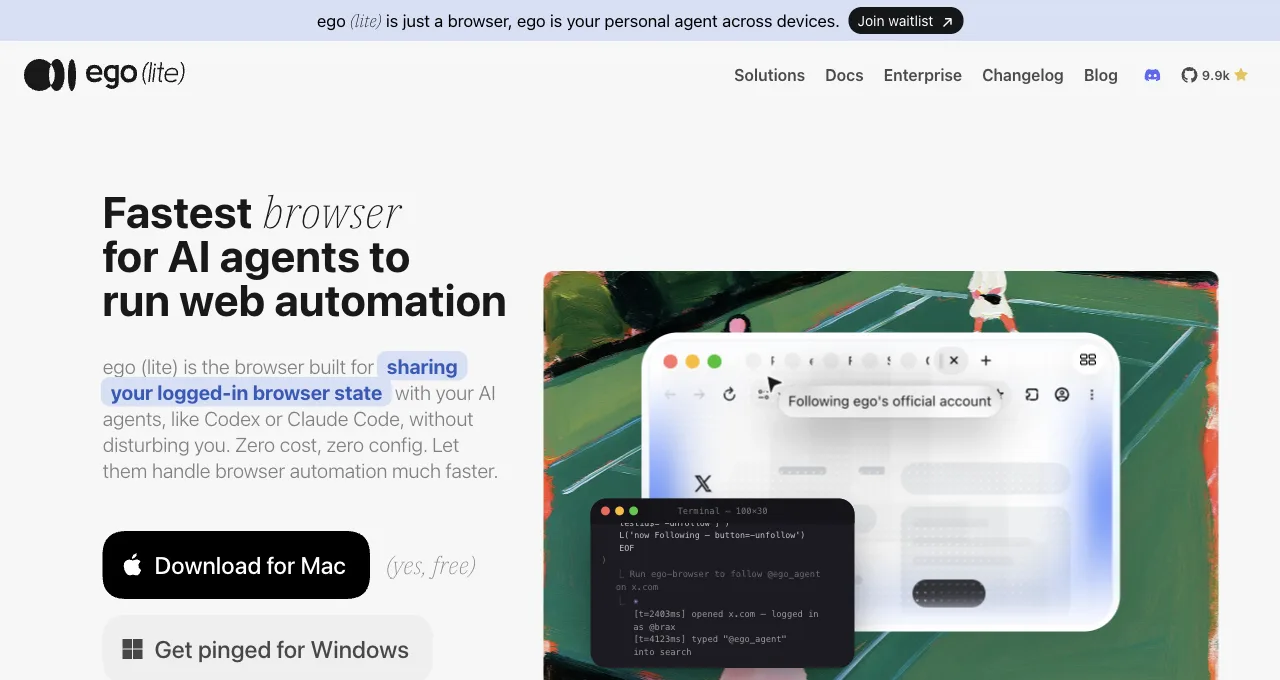
An ego (lite) Space can use eligible browser profile data imported from Chrome, so the agent works from the sessions you already hold. Imported sessions remain subject to each site's expiration, revocation, MFA, and access policy. The practical distinction is local profile persistence plus a separate, visible task workspace, not a promise that every authenticated page will stay accessible.
On the same Real-World Bench set, ego (lite) finished 93.5% of 31 tasks perfectly at an average $1.64 per task; $1.64 ÷ 93.5% completion works out to $1.75 per completed task.
ego (lite) + gpt-5.6-sol
# ego (lite) + gpt-5.6-sol: the model writes a targeted extract, ego-browser runs it
ego-browser nodejs <<'EOF'
const task = await egoBrowser.newTaskSpace('evidence-egobrowser-hn')
console.log({ taskSpaceId: task.id })

await task.page.goto('https://news.ycombinator.com/', { waitUntil: 'load', timeout: 20000 })
const title = await task.page.title()
const topStory = await task.page.locator('.athing .titleline > a').first().innerText()
const points = await task.page.locator('.subtext .score').first().innerText().catch(() => null)
console.log({ title, url: task.page.url(), topStory, points })
EOF

# Output:
{
  "taskSpaceId": 13
}
{
  "title": "Hacker News",
  "url": "https://news.ycombinator.com/",
  "topStory": "Qwen 3.8 27B",
  "points": "412 points"
}
The tradeoff for the whole route: it's not built for massive fixed pipelines the way an API is, and agent-driven runs can vary, so it fits flexibility over throughput.
This route also has a measured reference point: Real-World Bench, an open harness that runs 31 tasks, many shaped like actual scraping work rather than toy fetches. Examples from the set: search a stainless-steel water bottle's Amazon reviews for leak complaints through the review keyword box, pull a week of engagement metrics from x.com/OpenAI behind a login while excluding pinned posts and replies, and cross-compare Action-RPG review scores between PS5 and PC on Metacritic. The same model (gpt-5.6-sol at max effort) and independent judge were used for every tool. The no-code tools and scraping APIs weren't in the benchmark, so no head-to-head numbers are claimed for them. Harness, tasks, and raw verdicts: citrolabs/ego-browser-benchmark-framework.
Same task, same page, two recorded runs (the story's vote count moved between them): ego (lite) hands back a 4-field JSON in one shell call, browser-use spends an LLM step reasoning over the page and reports the answer in prose. Neither is wrong; they're different tradeoffs, targeted extraction versus autonomous reasoning, and the per-step reasoning token bill only shows up on the second one.
Download ego (lite) for Mac, free, or see the login-specific routes in AI scraping behind login walls.
Which AI web scraping tools fit each route?
Search results for AI web scraping tools mostly name products that already sit on one of the three routes above. The useful comparison is not a ranked 'best of' list. It is which route the tool actually belongs to, what its documentation claims, and which job it cannot honestly take.
| Tool | Route | Documented job | Boundary |
|---|---|---|---|
| ego (lite) | Agent-driven browser | A local browser with persistent profiles and isolated Spaces that a coding agent can drive for authorized, login-aware extraction. | Not a hosted crawl API or a no-code recorder. Session access still depends on the site. |
| Browse AI | No-code scraper | Positions itself as a no-code scraper and monitoring platform with visual field selection and third-party integrations. | A hosted runner holds the recorded session. Fast on one stable site; brittle after redesigns. |
| Thunderbit | No-code scraper | Calls itself an "Agentic Web Scraper" for one-click extraction from a page or small set of pages. | Vendor wording is agentic; the documented job is still a no-code start, not a local persistent browser. |
| AIScraper | No-code scraper | Describes itself as an "AI Powered No Code Web Scraping Tool" for defining fields without writing selectors. | Same class as Browse AI. Use vendor docs for current coverage; this page does not benchmark it. |
| Firecrawl | Scraping API | Turns URLs into markdown or structured JSON for LLM pipelines. Its 2026 roundup is a vendor list, not a third-party test. | Built for public pages at volume. Awkward for your own logged-in account. |
| Web Scraper Cloud | Scraping API / cloud | Enterprise crawl product. Its marketing lists proxy management, challenge handling, and a 99.99% uptime claim. | Treat uptime and bypass claims as vendor copy. Confirm current terms before a production crawl. |
| Gumloop | Workflow platform | Publishes its own 2026 AI-scraper roundup and can orchestrate scraping steps inside a no-code workflow. | Not a fourth scraping route. A workflow graph is not the same as a crawler, an API, or a local browser agent. |
Apify's comparison of AI Web Scraper, Parsera, Browse AI, and Kadoa.com (Apify blog) is useful as a reminder that even one category still splits on pricing, coverage, and maintenance. Pick the route from the table above, then read the vendor's current docs. Do not treat a listicle ranking as a measured benchmark.
Which route fits your job?
Four factors decide almost every real choice: how much data you're pulling, how often the source changes, whether it's behind a login, and what you can spend. Find the column you're weakest on and read down it, because that constraint, not the one you're comfortable with, is what picks the route.
| Factor | No-code scrapers | Scraping APIs | Agent-driven browsers |
|---|---|---|---|
| Data volume | Low to medium; one site at a time | High; built for thousands of pages | Low to medium; task-shaped, not bulk |
| Change frequency | Poor; re-record on redesign | Good on public pages; managed for you | Potentially resilient; still needs drift checks |
| Login walls | Works, but the runner holds your session | Awkward; built for public data | Can reuse an authorized signed-in browser |
| Budget model | Flat subscription by row or run | Usage-based; scales with volume | Free tools plus your agent's LLM tokens |
The pattern the table draws: APIs own scale and public data, agent-driven browsers own flexibility and logins, and no-code tools own the fast, non-technical start on a single stable site. A task that lives in two columns usually means two tools, not one heroic pick.
Once the table has named the weakest constraint, shortlist from the tool map above. A no-code start on one stable site points to Browse AI, Thunderbit, or AIScraper; a high-volume public crawl points to Firecrawl or Web Scraper Cloud; authorized login work points to an agent-driven browser such as ego (lite). Verify the current feature set and pricing on the vendor's site before committing.
What does each route cost?
Compare the cost model, not a sticker price, because the models scale so differently that today's cheapest route becomes tomorrow's most expensive at a different volume. The magnitudes below are about how cost behaves, not exact figures, which move too often to quote.
| Route | Cost model | Where it gets expensive |
|---|---|---|
| No-code scrapers | Free tier, then a monthly plan by rows or runs | Many sites or high row counts push you up tiers fast |
| Scraping APIs | Usage-based: pay per page or per credit | Cost rises linearly with volume; large crawls add up |
| Agent-driven browsers | Tool often free; you pay your agent's LLM tokens | Token cost per task; hosted-cloud options add infra |
How do you choose? A decision tree
Run the four questions in order and the route usually falls out by the second or third. This is the tree, in plain steps.
Start with the access boundary. If the data is behind an account you are authorized to use, compare a persistent local profile, an approved managed session, and a first-party export. Avoid copying session cookies into ad hoc scripts; MFA, device checks, expiration, and account policy can invalidate that approach. If no login is required, move to volume and data-shape requirements.
If you're pulling thousands of public pages on a schedule, a scraping API is the route: it's built for that scale and hands you clean, model-ready data without you running browsers.
If the volume is modest, ask about change and skill. A single stable site and no desire to code points to a no-code scraper for the fastest start. A source that changes often, or a task with varied steps rather than a fixed shape, points back to an agent-driven browser, where the model adapts instead of breaking.
Budget breaks ties: at low volume a local agent-driven route may avoid a hosted per-page fee, while still consuming model, compute, review, and maintenance time. At high public-data volume, an API's per-page price can still beat operating a browser workflow.
Try the free, login-aware route with ego (lite), or compare the agent tools directly in the 11 best browser automation tools.
How should AI agents handle anti-bot and Cloudflare protection?
Do not treat a Cloudflare challenge, CAPTCHA, 403, or rate limit as a puzzle to bypass. Treat it as an access decision: verify that you are allowed to collect the data, use an official API or licensed feed when available, slow or stop the run, and ask the site owner for an approved path. A real browser can display a challenge; it does not make evasion lawful or reliable.
Cloudflare describes its challenge pages as a way for a site to determine whether a request comes from a human, and Turnstile is designed to verify legitimate visitors without exposing a CAPTCHA in every case. Those controls belong to the site owner. Read the target site's terms and robots.txt as signals about intended access, but remember that robots.txt is not a permission grant or a substitute for a contract. Cloudflare's challenge-page documentation explains the distinction. Google's robots.txt documentation also makes clear that robots.txt controls crawling behavior; it is not a legal permission grant.
- Before the run. Confirm ownership, a written authorization, an API agreement, or another documented basis. Limit the fields, pages, frequency, and retention period to that basis.
- When a check appears. Record the URL, timestamp, response or visible challenge, and access_status. Do not solve a CAPTCHA, rotate identities, replay cookies, spoof fingerprints, or increase concurrency to force a result.
- When the block persists. Switch to a first-party export, a licensed dataset, a public API, or a manual handoff. If none exists, return a bounded partial result rather than claiming completeness.
Community threads keep circling the same failure. A Reddit user in r/webscraping asked how to get Claude to code around a site's CAPTCHA (Reddit thread), and practitioners on X report AI agents being blocked by Cloudflare (X post). Those posts are evidence of demand, not a method to copy. A challenge page is an access decision; treating it as a fingerprint, CAPTCHA, or patch puzzle is the opposite of this page's advice.
How do you make AI web scraping stable and reliable?
Make the scraper a small data pipeline, not one long prompt. Define an input and output contract, wait for a named page state, use bounded retries with backoff, deduplicate canonical URLs, validate every row, and checkpoint progress. Reliability comes from observable failure states and safe re-runs, not from asking a model to try harder.
- Give each run an idempotent key. Use a normalized URL plus query or account scope as the record key. Store the last checked time and schema version so a retry updates the same observation instead of creating a duplicate.
- Wait for the state you need. A page load event is not proof that a table, cursor, or chart is ready. Wait for a stable locator or a bounded timeout, then mark the state as loading, ready, empty, blocked, or failed.
- Retry only transient failures. Use exponential backoff for a network timeout or a temporary 5xx response. Do not retry a 401, 403, CAPTCHA, robots exclusion, or terms-based denial as if it were a flaky connection.
- Validate and checkpoint. Check required columns, types, URL shape, duplicate keys, and plausible ranges before writing a row. Save progress after each page or batch so a layout change does not erase a usable partial result.
How can you reduce token and cost overhead?
Send the model the smallest useful representation of a page and the smallest task that can answer the question. Extract links and visible text before asking for reasoning, cache unchanged pages, use a cheaper model for triage, and reserve a stronger model for ambiguous rows. Set a per-page and per-run budget so a loop fails closed instead of spending indefinitely.
- Reduce input bytes. Remove scripts, styles, navigation, repeated boilerplate, and unrelated sections before sending HTML to an LLM. Keep the source URL and a short page fingerprint for provenance.
- Separate extraction from judgment. Use deterministic locators or a small model to collect obvious fields, then call a larger model only for rows that fail validation or need comparison. One structured call per page is usually cheaper than a chatty click-by-click loop.
- Cache and deduplicate. Hash the normalized page content or store an ETag or Last-Modified value when the source provides one. Skip model work when the page has not changed, and do not spend tokens processing duplicate URLs.
- Measure the unit economics. Log input tokens, output tokens, browser time, retries, pages completed, and accepted rows. Compare cost per accepted row, not just cost per request, because a cheap run that needs manual repair is not cheap.
What free or open-source AI scraping tools can agents use?
Free software and free hosted usage are different promises. ego (lite) is free to download for Mac; Browser Use is an open-source browser-agent framework; and Playwright and Scrapy are open-source building blocks. Hosted extraction services may offer credits or a free tier, but rendering, proxies, storage, model calls, and support can still become billable. Check the current license and pricing before designing around a number.
| Tool or layer | Best free starting point | What you still operate |
|---|---|---|
| ego (lite) or Browser Use | Natural-language, task-shaped browser work | Agent model tokens, permissions, and human handoff |
| Playwright | Code-level browser control and tests | Runtime, browser profiles, retries, and extraction logic |
| Scrapy | Large, mostly public crawl pipelines | Spiders, politeness settings, item schemas, and storage |
Use an open-source library when you can own the selectors, scheduling, and data lifecycle. Use an agent-driven browser when the task is varied or requires a browser session you control. Neither category grants access to a site that has denied it, and neither eliminates the cost of the model or the work of maintaining a reliable pipeline.
Which scraping API fits price monitoring and specific use cases?
Choose a scraping API by the source and the service level you need, not by a generic best-tool list. For public price monitoring, compare rendering support, geographic coverage, freshness guarantees, rate limits, retry behavior, structured output, and total cost per accepted page. For private dashboards, books, or regulated pricing data, a first-party API or licensed feed is usually safer than an extractor that merely returns HTML.
- Public retail and marketplace pages. A managed API can be efficient when the same public pages are checked at scale. Confirm that the provider's access method and storage terms allow your monitoring use, and keep a timestamp and source URL for each price.
- Vendor pricing pages. Prefer a small, scheduled fetch with change detection over a full crawl. Store the old and new values, effective date, currency, and evidence URL so a plan comparison is explainable.
- Books, hospital pricing, or other specialized data. Search for an open catalog, government endpoint, publisher feed, or machine-readable disclosure first. A scraper cannot repair an ambiguous title, missing edition, or incomplete chargemaster; flag those records for review.
Examples of documented API approaches include Firecrawl's extraction documentation and ScrapingBee's API documentation. Treat these as implementation references, not endorsements or proof that every target permits automated collection.
How do you automate scraping with AI agents and no-code tools?
Use n8n, Zapier, or Power Automate as the orchestration layer and keep extraction as a bounded, testable step. A safe workflow receives a URL or schedule, checks authorization, calls an API or controlled browser task, validates the returned rows, and sends a report or approval request. It should not blindly retry a blocked page or write unverified leads into a CRM.
- Trigger with a narrow scope. Pass a list, query, or page owner into the workflow. Store the scope and authorization basis with the execution so a later operator can explain why it ran.
- Branch on access status. Send ready pages to extraction, empty pages to a diagnostic branch, and login, CAPTCHA, 403, or rate-limit states to a human or owner-approved alternative.
- Validate before side effects. Require schema checks, duplicate detection, and a minimum evidence threshold before sending an email, updating a CRM, or publishing a report. Keep a review queue for ambiguous rows.
- Schedule with backpressure. Use a queue or rate-limited worker for recurring jobs, persist checkpoints, and alert on drift. n8n's queue-mode documentation is a useful reference for separating trigger and worker capacity.
See n8n queue mode and the HTTP Request node documentation for orchestration details. Zapier and Power Automate have similar trigger, action, and approval concepts; their current limits and connector behavior should be checked before production use.
How do you export and validate scraped data?
Export a versioned CSV or JSON file only after validating the schema, provenance, completeness, and retention rules. Keep source_url, checked_at, access_status, and limitation beside the extracted fields; then test encoding, delimiters, types, duplicates, and nulls before importing into Excel, Google Sheets, a CRM, or a warehouse.
- Define a schema before extraction. Name required columns, types, allowed nulls, and the source timezone. A stable schema makes a changed page or missing field visible instead of silently shifting values into the wrong column.
- Preserve provenance. Store the canonical URL, retrieval time, access status, parser or prompt version, and any pagination or visibility limitation. For a recurring report, retain the prior file or a diff so a change can be audited.
- Run mechanical checks. Open a sample in the intended destination, verify UTF-8 and CSV quoting, parse JSON, check required URLs, count duplicates, and compare accepted rows with blocked or empty rows. Never convert a blocked row into an empty success.
- Control sharing and deletion. Send only the fields the recipient is allowed to receive, limit access to the export, and delete temporary HTML, screenshots, cookies, or personal data when the stated retention period ends.
FAQ
How do I scrape website data with an AI agent?
Give an AI agent a bounded URL list, the exact fields to extract, and a CSV or JSON schema that includes source_url, checked_at, and access_status. Use a rendered browser for dynamic or authorized pages, stop at login or bot checks, and review the source-linked output before using it. The step-by-step workflow is above.
What is the best AI web scraping tool in 2026?
It depends on the job. For thousands of public pages, a scraping API like Firecrawl or ScrapingBee is best; for a single stable site with no code, a no-code scraper like Browse AI or Simplescraper; for login-walled or varied tasks, an agent-driven browser like ego (lite) or Browser Use. There's no universal winner, only a best fit per volume, change frequency, login wall, and budget.
Is there a free AI web scraping tool?
Some tools have a free software or trial tier, but a complete workflow can still incur model, compute, browser, storage, and review costs. ego (lite) is free to download and Browser Use is open-source; hosted services, account plans, and the agent's model calls are separate. The dated Real-World Bench figure above is an observed task-suite result, not a promise of current cost or success rate. Check each provider's current license and pricing before scaling.
How do I do AI web scraping with Python?
Two common paths. Call a scraping API from Python and let it return clean data, which suits public-page pipelines. Or drive a browser from Python with a framework like Playwright and pass the page to a model for extraction, which handles dynamic sites. For pages behind your own login, an agent driving a real signed-in browser avoids the cookie-injection upkeep that raw Python scripts require.
How do I scrape website data into a spreadsheet?
Give the agent a bounded list of source pages and name the columns you need, such as title, price, date, URL, and status. Ask for CSV first: it opens directly in Excel or Google Sheets and keeps source_url, checked_at, and access_status beside every value. For JavaScript-rendered or authorized pages, have the agent extract from the rendered browser session; for a large public crawl, a scraping API may be more efficient. Mark missing fields as not displayed and review a sample of source links before sharing the sheet.
Can I scrape website analytics from any site?
Not the private metrics people usually mean by analytics. An Agent can record counters, reviews, prices, structured metadata, and other fields a public page visibly exposes, but it cannot derive reliable visits, traffic sources, conversions, search queries, or audience demographics from the rendered page alone. For a site you own, use its analytics or server logs; Google Search Console provides impressions, clicks, queries, pages, and countries after you verify site ownership. ego (lite) can read a dashboard your authorized session can already open and preserve its source and check time, but it does not reveal a competitor's hidden analytics. Treat third-party traffic estimates as estimates from a separate provider, not scraped facts.
Can AI scrape websites behind a login?
Only when you are authorized to access and collect the data. For an approved use case, the sturdiest path is an agent driving a browser that's already signed in, so nothing is copied out and 2FA becomes a pause rather than a failure. ego (lite) does this by inheriting your existing sessions. No-code tools can record a login flow but hold your session on their runner, and scraping APIs are built for public data, not your personal account. See the login-wall guide for the full comparison and compliance boundaries.
Can I extract leads from a website with an AI agent?
Yes, for a bounded list of pages and fields the page visibly displays—such as a business name, public contact link, role, company URL, or public social link—provided you are allowed to collect it. Ask the Agent to keep the source URL, checked-at time, access status, and a limitation for every row. This is webpage field extraction, not an identity or email-enrichment service: it does not infer people, reveal hidden addresses, query a purchased database, or verify a contact beyond what an authorized public source shows.
Does AI web scraping break when a website changes?
A model can tolerate some presentation changes because it re-reads page content, but no approach is immune to redesigns, renamed fields, missing data, or access blocks. Recorded no-code flows, selectors, agent prompts, and API parsers all need monitoring. Add canary runs, source-linked validation, versioned parsers, and a human or first-party fallback when the expected contract fails.
Is AI web scraping legal?
Legality depends on the data, jurisdiction, authorization, method, purpose, and contract, not on whether a page is publicly visible. An authenticated account can still expose third-party personal data, copyrighted material, or information governed by platform terms. Define a lawful basis, collect only what is necessary, respect access controls, and obtain legal advice for regulated or commercial-stakes uses.
Is Browse AI good for scraping behind login walls?
Browse AI can record a login flow, but the hosted runner then holds that session on its infrastructure (Browse AI). That is a third-party session decision, not a local profile. For a login-walled site you are authorized to use, an agent-driven browser with a persistent local profile, such as ego (lite), keeps the session on your machine. It still cannot collect data you are not allowed to collect.
What is Thunderbit used for?
Thunderbit markets itself as an "Agentic Web Scraper" for one-click extraction (Thunderbit). That documented job is a no-code start on a page or small set of pages, not a guarantee that every site will yield data. For larger public crawls use a scraping API; for authorized, login-aware work use an agent-driven browser.